
Natural & Neutral Wall Decor Ideas for the Living Room and Bedroom
A neutral room is easy to love and surprisingly easy to get wrong. White walls, an oatmeal sofa and pale oak can feel calm, or they can feel flat. The difference is rarely colour. It is texture, scale and light, and the wall is where all three show most. These are the natural wall decor ideas we return to most often: room by room, with sizes that work.
Start with materials, not colours
Neutral wall decor works when the materials carry the interest that strong colour would otherwise bring. Wool, linen, pine, oak, clay and stone all vary slightly in tone, and the eye reads that variation as warmth. A beige print stays flat. A handwoven piece has depth, because every row of the weave catches the light a little differently. That is the case for natural fiber wall art in a quiet room: it adds interest without adding noise.
Keep the palette in one temperature. Warm white, cream, sand and greige belong together, and so do cool white and blue grey. Mixing the two is what makes a neutral room look accidental. Our minimalist and neutral tapestries are a good place to see warm, quiet tones side by side.

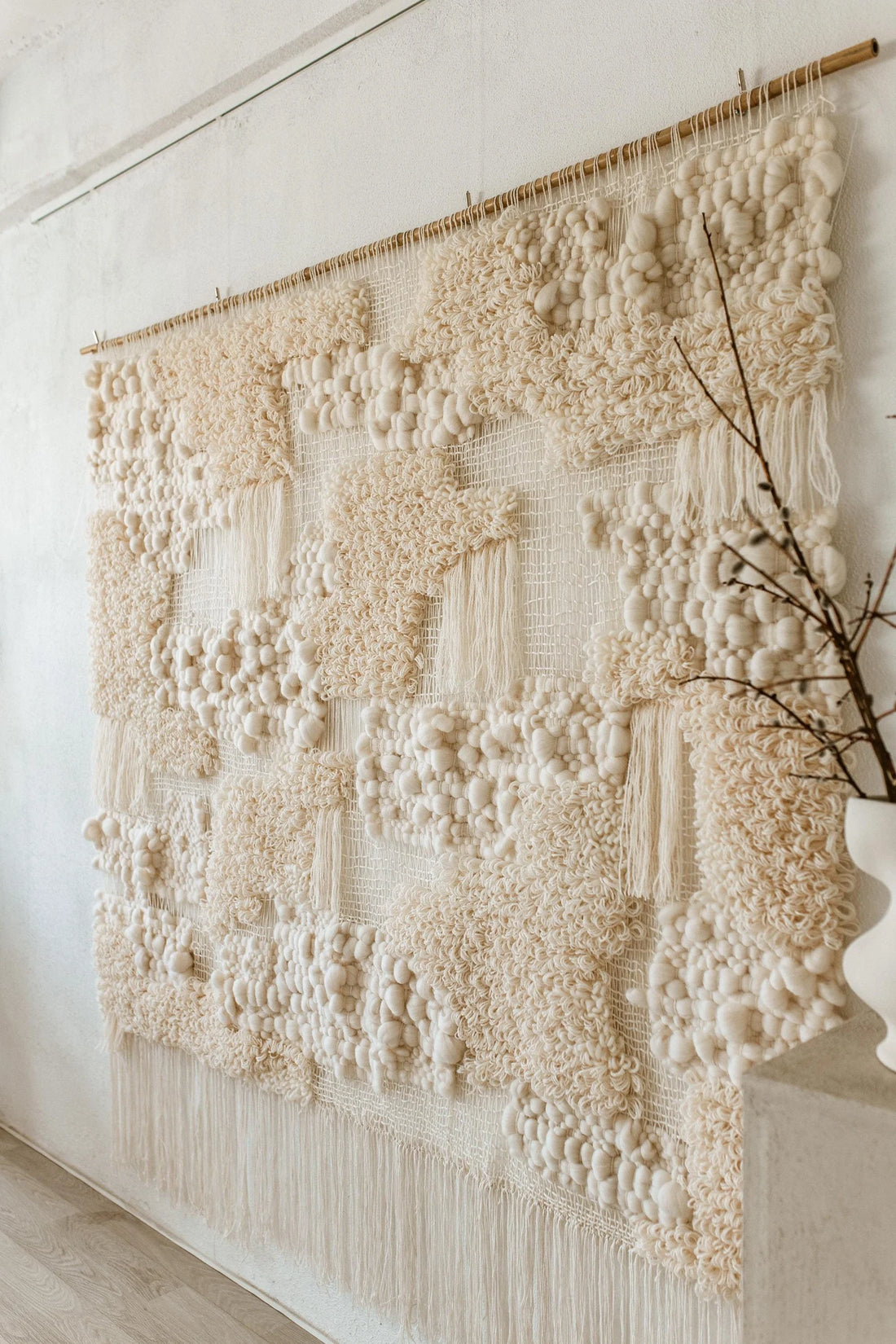
Sound on a bamboo rod.
Living room wall decor ideas: above the sofa
The wall above the sofa is usually the first one people dress, and the most common mistake is going too small. Aim for a piece, or a group of pieces, about two thirds of the width of the sofa, hung 6in to 10in (15cm to 25cm) above the back, so that the sofa and the art read as one composition.
- A two-seat sofa, around 60in (150cm) wide: one 39in x 39in (100cm x 100cm) piece.
- A three-seat sofa, around 85in (215cm) wide: two 24in x 39in (60cm x 100cm) pieces hung side by side, or one wide piece on a rod.
- A long sofa or an open-plan wall: one of our large woven wall hangings, with a longer side of 47in (120cm) or more.
When you choose a wall tapestry for the living room, think about how the room sounds as well as how it looks: wool softens echoes, which helps in rooms with hard floors and large windows.

FruFru above the sofa.
Bedroom wall decor: above the bed
Bedroom wall decor should be the quietest in the house. You see it first thing in the morning and last thing at night, so choose soft contrast and a texture you want to touch. Centre the piece over the headboard, keep it to about two thirds of the width of the bed, and leave 6in to 10in (15cm to 25cm) between the headboard and the lower edge of the piece.
As a rough guide, above a bed about 60in (150cm) wide, a 39in x 39in (100cm x 100cm) piece comes close to two thirds. Above a very wide bed, two framed pieces hung as a pair work well, or the same single square if you prefer more wall around it. Framed tapestries give a clean edge against bedding and plaster. A piece on a bamboo rod, with a fringe, feels softer and a little more relaxed.

Klit, 24in x 39in (60cm x 100cm), above the bed.
Hallway and entryway
Hallways are narrow, so you see the wall from close up and often at an angle. That favours texture over pattern: loops, relief and fringe read beautifully at arm's length. A vertical 24in x 39in (60cm x 100cm) framed piece above a slim console is a combination that rarely fails. In a stairwell or a double-height entrance, go bigger than feels natural, because the wall is larger than it looks from the bottom step.

Olit above a hallway console.
Dining room
In a dining room, centre the piece on the table or the sideboard rather than on the wall, and hang it a little lower than you would in a hallway, so that it relates to people sitting down. A square format sits calmly above a long table, and a pair of matching pieces works well above a wide one. Keep woven pieces out of steamy kitchens, though.

Balanse, 32in x 32in (80cm x 80cm), in a dining room.
Texture: what makes neutral work
With strong colour out of the picture, texture does the work. Combine at least two kinds in one room: a tight, flat weave with a looped or fringed one, or a smooth plaster wall with a deeply textured piece. Our textile wall art runs from flat, graphic weaves to deep relief. If your home leans Japandi, our Japandi wall art guide goes further.

Velua up close.
Scale: when in doubt, size up
A piece that is too small looks like an afterthought. Before you buy, mark the size you are considering on the wall with paper or painter's tape, and live with it for a day or two. Our framed tapestries come in six standard sizes: 18in x 30in (45cm x 75cm), 24in x 24in (60cm x 60cm), 24in x 39in (60cm x 100cm), 32in x 32in (80cm x 80cm), 32in x 48in (80cm x 120cm) and 39in x 39in (100cm x 100cm). If none of them fits your wall, we weave custom sizes. Our guide on how to choose the right size framed tapestry works through more examples with real furniture widths.

Two extra large Huek pieces beside the weaver who made them.
Light: how natural wall decor changes through the day
Woven surfaces change with the light. Side light from a window rakes across the weave and shows every row; in the evening, a lamp placed to one side does the same. A wall at a right angle to the window often gives you the best of both. Avoid spots that get strong, direct sun for hours, because prolonged direct sunlight can fade colours over time.
Caring for natural fiber wall art
Wool asks for very little. Dust it now and then with a soft, dry cloth, and do not clean it with water. Every piece we make is woven by hand in 100% wool in our studio in Chrzanów, Poland, and framed pieces have four mounting brackets on the back. Our guide on how to hang heavy wall art covers walls, fixings and heights.
Not sure which piece suits your wall? Try it on a photo of your own room.
Where to start
- Minimalist and neutral tapestries: calm, low-contrast pieces for quiet walls
- Framed tapestries: six standard sizes in solid wood frames
- Large woven wall hangings: for long sofas, wide beds and stairwells
- Textile wall art: from flat weaves to deep relief